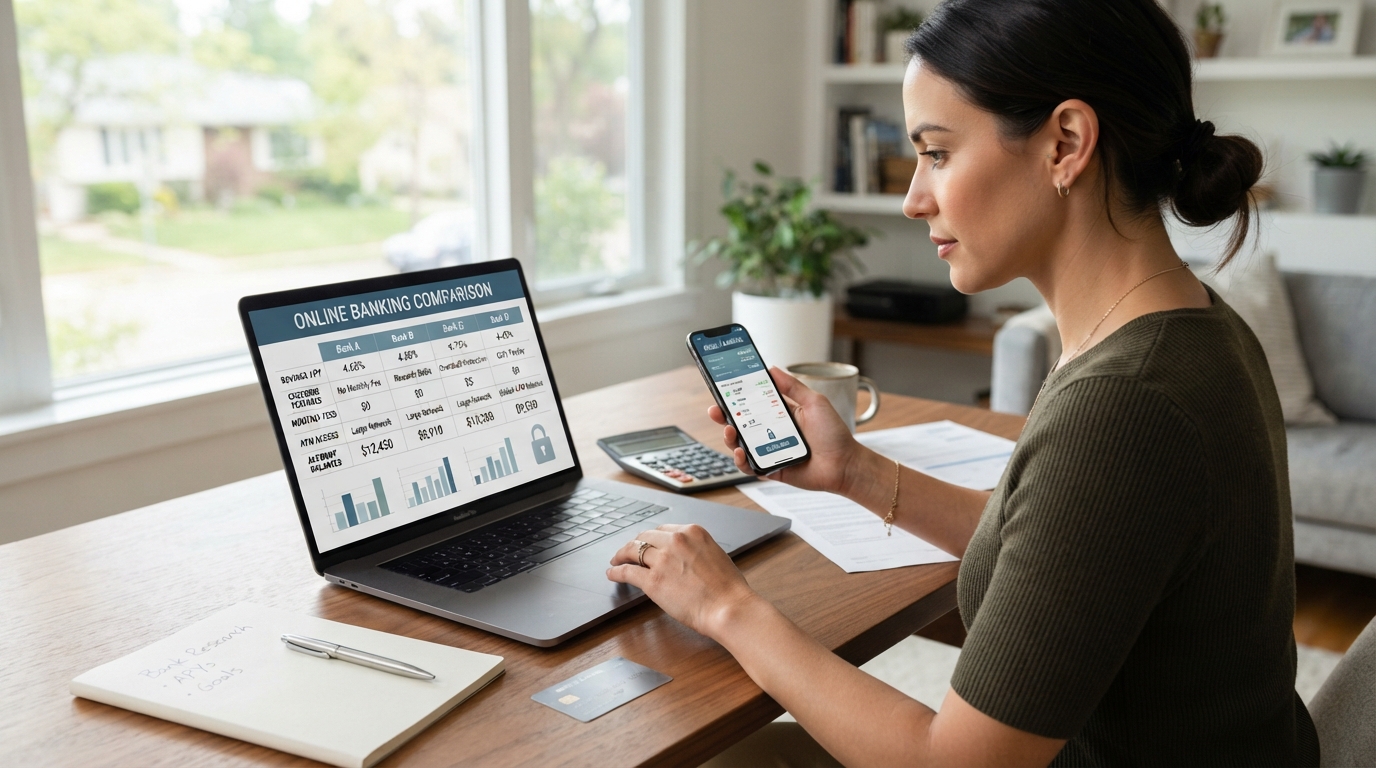
Online banking has changed how consumers manage everyday finances. Instead of visiting a branch to open an account, transfer money, deposit a check, or monitor spending, customers can complete many banking tasks through a mobile app or website.
The best online banks in 2026 combine competitive interest rates, low fees, convenient digital tools, strong security, and reliable customer service. However, there is no single bank that is ideal for every customer. The right choice depends on whether you prioritize checking, savings, ATM access, cash deposits, CDs, budgeting tools, or a broader range of financial products.
Current 2026 comparisons show that online banks can offer competitive yields and lower fees than many traditional banking options. Forbes Advisor’s latest review analyzed 60 online institutions using factors including rates, fees, ATM networks, product offerings, digital features, and customer experience. (Forbes)
What Is an Online Bank?
An online bank is a financial institution that primarily provides banking services through websites and mobile applications rather than a large network of physical branches.
Customers can typically use online banking to:
- Open checking and savings accounts
- Deposit checks through mobile apps
- Transfer money
- Pay bills
- Receive direct deposits
- Monitor transactions
- Set up automatic savings
- Apply for financial products
- Manage debit cards
- View statements
- Contact customer support
Because online banks generally operate with fewer physical branches, some can use their lower operating costs to offer competitive rates or reduced account fees.
Best Online Banks in 2026
The following institutions stand out in current 2026 comparisons for different banking needs. These are not universal rankings because the best choice depends on your financial priorities.
1. Varo Bank: Best for Digital Banking
Varo Bank is a strong option for consumers who want a digital-first banking experience.
Current 2026 reviews highlight Varo’s mobile banking features, savings options, ATM access, and lack of monthly maintenance fees. Its highest advertised savings rate may require qualifying direct deposits and may apply only to balances within a specified limit. (Forbes)
Potential advantages:
- Mobile-focused banking
- Competitive savings opportunities
- No monthly maintenance fee
- Large ATM network
- Mobile check deposit
- Early direct deposit features
Potential drawbacks:
- Limited product selection compared with full-service banks
- Conditions may apply to the highest savings APY
- Cash deposits may depend on third-party retail locations
2. SoFi Bank: Best for Full-Service Online Banking
SoFi is designed for customers who want multiple financial products within one digital ecosystem.
Its offerings include checking and savings accounts along with products such as investing, credit cards, and personal loans. Current 2026 reviews also highlight its competitive rates, broad ATM access, and lack of certain common account fees. (Forbes)
Potential advantages:
- Checking and savings in one platform
- Competitive interest rates
- No monthly maintenance fees
- No minimum balance requirements
- Extensive ATM network
- Additional financial products
- Digital budgeting and financial-management tools
Potential drawbacks:
- Highest APY may require qualifying conditions
- Some products may not be available to every customer
- Limited physical branch access
3. Marcus by Goldman Sachs: Best for Customer Support
Marcus is primarily focused on online savings and certificates of deposit rather than traditional everyday checking.
Current 2026 comparisons highlight Marcus for its 24/7 customer service through phone and live chat, along with competitive savings and CD rates. (Forbes)
Potential advantages:
- 24/7 customer support
- Competitive savings rates
- CD options
- Established financial institution
- No traditional branch visits required
Potential drawbacks:
- Limited everyday banking products
- No traditional checking account offering in the reviewed lineup
- Early-withdrawal penalties may apply to CDs
4. Ally Bank: Best for Savings Tools
Ally Bank offers a broad selection of digital banking products, including checking, savings, money market accounts, and CDs.
Its digital savings tools include features designed to help customers organize money into separate savings goals and automate saving. Current 2026 reviews also highlight its lack of monthly maintenance fees and minimum deposit requirements. (Forbes)
Potential advantages:
- Savings organization tools
- Automatic savings features
- Checking and savings accounts
- CDs and money market accounts
- No monthly maintenance fees
- Broad digital banking functionality
Potential drawbacks:
- No extensive physical branch network
- Cash deposits may require specific methods
- Savings rates can change
5. American Express National Bank: Best for Interest-Bearing Checking
American Express National Bank is another online option worth considering for customers who value checking-account rewards.
Its Rewards Checking account offers interest and Membership Rewards points on eligible debit-card purchases. The bank also offers savings accounts and CDs. (Forbes)
Potential advantages:
- Interest-bearing checking
- Rewards on eligible debit-card purchases
- Savings account
- CD products
- 24/7 customer service
- Large ATM network
Potential drawbacks:
- Product selection is narrower than some full-service banking platforms
- Certain fees may apply
- Online-focused service means limited physical branch access
How Online Banks Make Money
Online banks generally generate revenue through many of the same mechanisms as traditional banks.
These can include:
- Interest earned from lending
- Fees for certain services
- Credit products
- Investment-related services
- Interchange revenue from card transactions
- Other financial products
The absence of physical branches does not mean an online bank operates without costs. It simply has a different cost structure.
Why Online Banks Can Offer Competitive Rates
One reason consumers consider online banks is the potential for competitive savings yields.
Traditional banks may maintain extensive branch networks, which can involve significant expenses. Online banks generally have fewer physical locations and may operate with a more digital-focused infrastructure.
Some of those cost differences can translate into competitive savings rates or lower account fees.
That does not mean every online bank automatically offers a better rate. Consumers should compare the actual APY and account requirements before opening an account.
What to Look for in an Online Bank
Choosing an online bank should involve more than searching for the highest advertised APY.
1. Annual Percentage Yield
If you are opening a savings account, APY is one of the most important factors.
A higher APY can help your savings grow faster, assuming the rate remains unchanged and the account terms are otherwise comparable.
However, some advertised rates may require direct deposits, minimum balances, or other qualifying activity. (Forbes)
2. Monthly Fees
Look for accounts with minimal or no monthly maintenance fees.
Also examine:
- Overdraft fees
- ATM fees
- Wire-transfer fees
- Foreign transaction fees
- Paper statement fees
- Other service charges
A bank advertising a high APY can become less attractive if you regularly pay unnecessary fees.
3. ATM Access
ATM availability matters more if you frequently withdraw cash.
Some online banks participate in large fee-free ATM networks, while others reimburse certain out-of-network charges.
For example, current comparisons show some leading online banks providing access to tens of thousands of ATMs. (Forbes)
4. Cash Deposits
Online banking becomes less convenient if you regularly handle physical cash.
Before opening an account, determine whether the bank supports cash deposits and where those deposits can be made.
5. Mobile Banking App
A strong mobile app should make it easy to:
- Check balances
- Transfer money
- Deposit checks
- Lock cards
- Review transactions
- Set alerts
- Contact support
Digital banking is only useful if the technology works reliably.
6. Customer Service
Customer support becomes particularly important when you cannot visit a physical branch.
Check whether the bank offers:
- Phone support
- Live chat
- Email support
- 24/7 assistance
- Secure messaging
Current online-bank comparisons show substantial differences in customer-service availability between institutions. (Forbes)
7. Deposit Insurance
Before depositing significant amounts of money, verify that the bank is federally insured.
The FDIC generally insures eligible deposits at FDIC-insured banks up to the applicable coverage limits. The standard maximum deposit insurance amount is $250,000 per depositor, per insured bank, for each ownership category.
You should confirm the institution’s current insurance status and understand how coverage applies to your accounts.
Online Banks vs. Traditional Banks
Both options have advantages.
| Feature | Online Banks | Traditional Banks |
|---|---|---|
| Physical branches | Limited or none | Usually available |
| Mobile banking | Usually strong | Varies |
| Savings rates | Often competitive | Often lower, depending on account |
| Monthly fees | Often lower | Can vary |
| ATM access | Network-dependent | Often extensive |
| Cash deposits | May be limited | Usually easier |
| In-person support | Limited | Available |
| Digital tools | Usually a major focus | Varies by institution |
The best option depends on how you actually use your bank.
Someone who rarely handles cash may have little need for branches. Someone who frequently deposits cash may consider physical access much more important.
Are Online Banks Safe?
Online banks can be safe when customers choose legitimate, federally insured institutions and follow appropriate security practices.
Look for:
- FDIC insurance
- Encryption
- Multi-factor authentication
- Transaction alerts
- Card controls
- Fraud monitoring
- Secure login procedures
You should also use a unique password, enable multi-factor authentication where available, and avoid accessing financial accounts through unsecured public networks.
Federal deposit insurance protects eligible deposits if an insured bank fails. It does not protect against every type of fraud, investment loss, or unauthorized transaction.
How to Choose the Best Online Bank
Use a structured comparison process before opening an account.
Step 1: Decide What You Need
Determine whether you primarily need:
- Checking
- Savings
- CDs
- Money market accounts
- Credit products
- Investing
- Business banking
Step 2: Compare Costs
Look at monthly fees, overdraft policies, ATM fees, transfer fees, and other charges.
Step 3: Compare Interest Rates
For savings and interest-bearing checking accounts, compare APYs.
Do not rely solely on promotional rates.
Step 4: Check Account Requirements
Read the fine print for:
- Minimum deposits
- Minimum balances
- Direct-deposit requirements
- Qualifying transactions
- Rate restrictions
Step 5: Examine ATM Access
Determine whether the bank provides fee-free ATM access where you live and travel.
Step 6: Test the Digital Experience
If possible, review the app and website before committing.
Step 7: Verify Insurance
Confirm that deposits are protected by the appropriate federal insurance program.
Common Mistakes to Avoid
Choosing Only Based on APY
The highest rate is not automatically the best deal.
Ignoring Fees
A few recurring fees can offset the interest you earn.
Forgetting About Cash Deposits
An online-only account may be inconvenient if your financial routine involves frequent cash deposits.
Overlooking Customer Service
When something goes wrong with a financial account, access to responsive support matters.
Keeping Excessive Funds Without Understanding Insurance Limits
If your deposits approach insurance limits, understand how coverage applies before moving additional funds into the same institution.
Opening Too Many Accounts
Multiple accounts can help organize finances, but excessive account fragmentation can make budgeting and financial management more difficult.
Frequently Asked Questions
What is the best online bank in 2026?
There is no single best online bank for everyone. Current 2026 comparisons identify different institutions for different priorities, including full-service banking, savings, customer support, digital tools, and ATM access. (Forbes)
Are online banks better than traditional banks?
Not necessarily. Online banks may offer competitive rates and lower fees, while traditional banks can provide branch access and convenient cash services. Your banking habits should determine which option is more suitable.
Are online bank accounts FDIC insured?
Many online banks are FDIC-insured, but you should verify the specific institution before depositing money. Eligible deposits at an FDIC-insured bank are generally covered within applicable insurance limits.
Do online banks have ATMs?
Some online banks operate their own ATM networks, while others use partner networks. Some also provide ATM-fee reimbursements. Check the bank’s current ATM policy before opening an account.
Can I deposit cash into an online bank?
It depends on the institution. Some online banks allow cash deposits through participating retail locations, while others do not accept cash deposits.
What is the biggest disadvantage of an online bank?
The biggest drawback for some customers is the lack of physical branches. Customers who frequently need face-to-face assistance or cash services may prefer a bank with local locations.
Final Thoughts
The best online banks in 2026 offer a combination of competitive rates, low fees, useful digital tools, strong security, and convenient access to everyday banking services.
However, the right bank depends on your priorities. If you want a full digital banking ecosystem, a bank such as SoFi may be worth evaluating. If savings tools are more important, Ally can be considered. Customers prioritizing customer support may look at Marcus, while those interested in digital-first banking can compare Varo and other online-focused institutions. Current independent comparisons support different choices depending on the specific banking need. (Forbes)
Before opening an account, compare the APY, fees, ATM access, cash-deposit options, account requirements, customer service, digital features, and deposit insurance.
Most importantly, verify current rates and terms directly with the bank. Banking products change frequently, and an account that looks attractive today may have different rates or requirements later.